

This is a pricing letter. Four times a year I will send you what freight, raw materials and labor are actually doing to the cost of running a shop in New Jersey, with every figure dated and attributed, plus the arithmetic on our own soap. Anything I cannot source, I leave out and say so.
Pricing Notices
The recurring section. What moved this year that changes what you pay — freight, resin, board, film, feedstock and labor. A couple of these were never announced in a way you would have noticed.
Parcel freight
If you ship anything at all, 2026 arrived in layers rather than in one announcement you could plan around.
One more landed four days before this went out. On August 2 UPS added a $5.00 per-package Non-Compliant Label Fee on Ground Saver, charged when a label or shipping system does not meet its requirements. If your labels come out of an older system, check them this week rather than next quarter (UPS rates and surcharges).
The one that did not make the headlines
This one is worth acting on, because it raised bills without changing a single published rate. It was published in the Postal Bulletin rather than announced as a rate increase, which is why it is easy to miss.
Carriers bill you on whichever is greater: actual weight, or dimensional weight — length times width times height, divided by a number called the divisor. On July 12 USPS cut that divisor from 166 to 139 and began rounding every dimension up to the next whole inch. It applies to Priority Mail Express, Priority Mail, Ground Advantage and Parcel Select, and only to parcels over one cubic foot — 1,728 cubic inches. Below that, nothing changed (Postal Bulletin PB22705).
-
1 · The carton
18 × 14 × 8 in · 2,016 cu in
Actual weight 8 lb, and over the 1,728 cu in threshold, so dimensional weight governs. Nothing about the box changed.
-
2 · The divisor
2,016 cu in166139One number moved on July 12, 2026. No rate card changed.
-
3 · The bill
+19.4% in dimensional weight. Billed weight rounds up to the next whole pound, so this carton goes from 13 lb to 15 lb.
This one lands on us directly. Our checkout quotes live USPS and UPS rates from the real measured dimensions of every carton we ship, so the day the divisor moved, our quotes moved with it. If you are still quoting freight off a flat table built a couple of years ago, that gap has been coming out of your margin since July and it will not announce itself.
Measure your most common cartons this week and check which ones clear 1,728 cubic inches.
Resin, board and film
These were left out of the planning for this issue because they could not be sourced to a standard worth printing. They can be now, so here they are.
Polyethylene. Blow-molding HDPE export spot ran from 35¢ a pound in late February to 80¢ in the second half of April, then corrected to 62–66¢ by May 22. On the contract side, increases of 5¢ in January, 10¢ in March and 30¢ in April were implemented, June gave back 15¢, and as of mid-July contract polyethylene was still about 30¢ a pound above where it started the year. Producers have nominated another 5¢ for August. There is no confirmation it was implemented market-wide, so treat it as announced, not landed (PetroChem Wire/OPIS, Resintel).
That distinction matters more than it sounds. Dow nominated 20¢ for June and it did not stick — prices fell 15¢ instead. A nomination is a letter, not a price.
Stretch film. LLDPE butene, the principal stretch-film resin, marked 64¢ a pound on the March US contract and 77–80¢ on April export spot. Finished film diverges from resin with gauge, freight and converter margin, so read that as direction rather than as your invoice.
Containerboard and boxes. Index moves of −$20 in February, +$40 in March, +$30 in April and +$50 in June net out to +$100 a ton through June. A third increase of $140 a ton has been announced for September 1 and has not been realized yet. The driver is supply: about 3.9 million tons, roughly a tenth of US capacity, has been retired since February 2025 (Fastmarkets).
What that means for a box buyer is harder to state honestly. At an average board weight of about 122 lb per thousand square feet, the realized $100 a ton is roughly $6.10 per MSF of material cost, before converting, freight and margin. There is no defensible market-wide percentage for finished box prices — it varies too much by supplier, geography and contract — and we would rather give you the material math than invent an average.
What the soap itself is made from


Malaysian crude palm oil averaged RM 4,532 a tonne on August 5, up 7.2% from a year earlier (MPOB). Over the same stretch two biodiesel programs expanded: Malaysia began a gradual B15 rollout in Peninsular Malaysia on June 1, and Indonesia started nationwide B50 in July.
The tempting next sentence is that everything made from palm follows crude palm oil up. It does not, and this year is a clean illustration. The closer benchmarks for the lauric feedstock that goes into hand cleaners moved apart: palm kernel oil was nearly flat, up 1.1% from September to July, while coconut oil fell 25.7% over the same stretch. Crude glycerin in Southeast Asia rose about 42% between July 2025 and April 2026 on the Argus Southeast Asia assessment; there is no August reading worth citing, so treat that as through April only.
If you buy cleaners or lubricants in volume, watch palm kernel and coconut and your own fatty-acid contracts. Crude palm oil is the headline number, and it is the wrong one to plan from.
New Jersey labor
Labor is not something we sell, but it moves the cost of running a shop, so it belongs in a pricing letter.
New Jersey's minimum wage went to $15.92 an hour on January 1, from $15.49. Employers with fewer than six workers and seasonal employers are at $15.23; agricultural is at $14.20. The general rate is indexed to the August-to-August change in CPI-W, and the state has to publish the next one by September 30 — so the 2027 figure is not out yet, and anyone quoting you one is guessing (NJ Department of Labor).
For contract cleaning, the 32BJ New Jersey schedule puts full-time commercial rates at $21.95 an hour in Newark and on the Hudson waterfront from October 1, up 1.9%, and $20.40 in the North Jersey suburbs, up 2.0%. Total employer cost on the Newark schedule rises 3.0%, to $31.02 (SEIU 32BJ contract schedule).
What a liter of hand cleaner costs
Our own numbers, worked in the open, on the same basis we would want from a supplier.
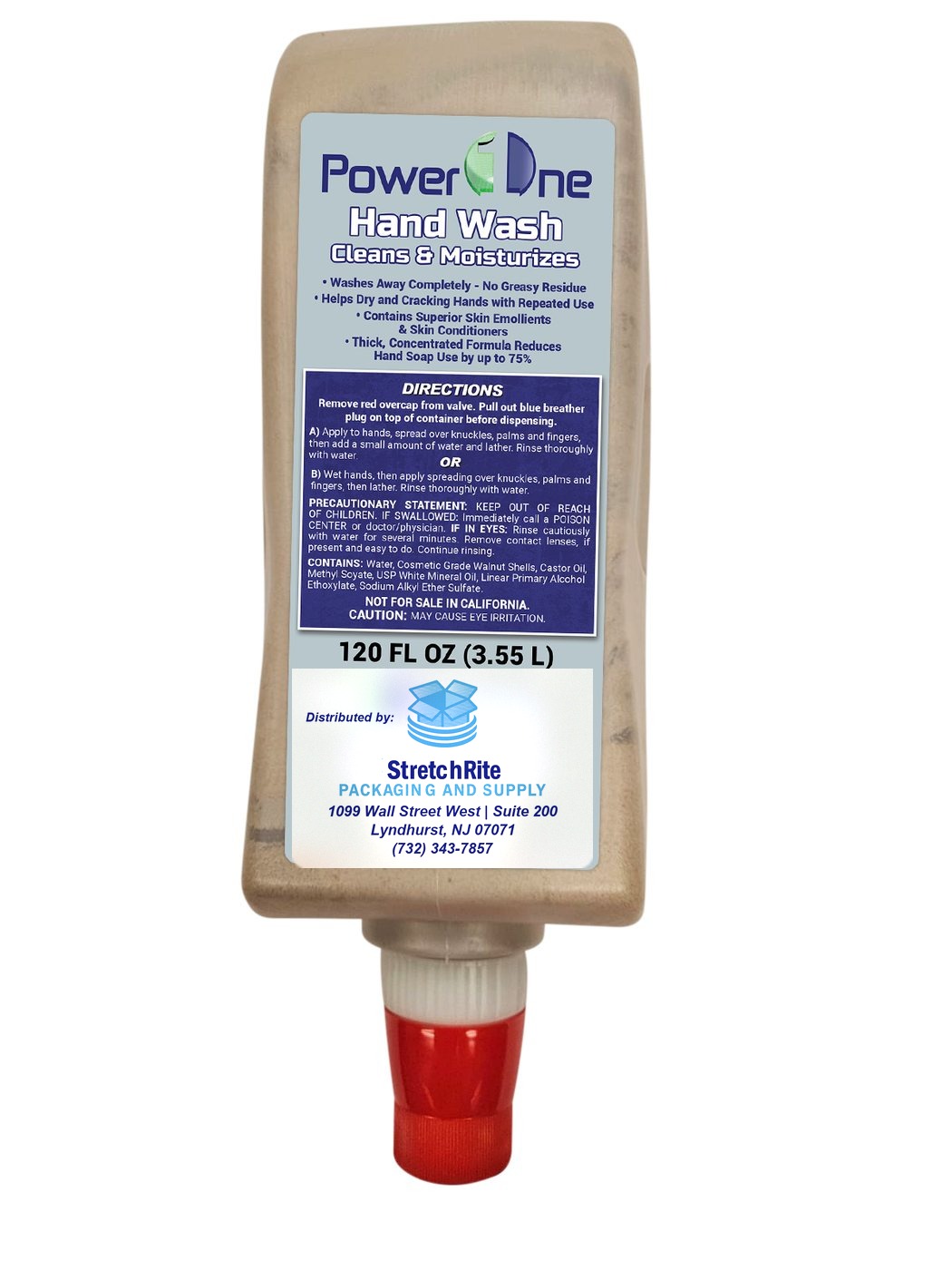
washes per 3.55 L jug
Power One dispenses neat — one metered pump, nothing to mix. That pump delivers about 5 mL. 3,550 mL ÷ 5 mL = 710 washes a jug.
| What you buy | Volume | Washes | Price | Per wash | Per liter |
|---|---|---|---|---|---|
| 400 mL refill | 400 mL | 80 | $11.95 | $0.149 | $29.88 |
| 3.55 L refill | 3,550 mL | 710 | $35.40 | $0.050 | $9.97 |
| Case of four | 14,200 mL | 2,840 | $140.50 | $0.049 | $9.89 |
Two things fall out of that table.
First: the 400 mL bottle is the most expensive way to buy this soap — three times the per-wash rate of the jug. It is a trial size. It is for finding out whether you like it. If you already know you do, move to the 3.55 L or the case and stop paying for packaging.
Second: there is no cost-per-wash comparison in here against another manufacturer, and that is deliberate.
Cost per wash is dose divided into volume, so it only means anything when both doses are known. Ours is a 5 mL metered pump. For the nearest comparison, GOJO NATURAL* ORANGE Pumice 7255-04, GOJO publishes no milliliters-per-push figure for the cartridge. Without it the calculation cannot be done — it would come out wherever the assumed dose put it, which makes it an assumption dressed as arithmetic. So it is not in here.
What can be compared is price against volume, because both are printed on the invoice.
On that basis our 3.55 L jug runs about 30% less per liter than the cheaper of the two GOJO case prices that could be verified this month. Against that, Power One is a true concentrate at only about 20% water, carries nearly 20% walnut-shell scrubbers, uses no petroleum solvents, and is USDA Certified Bio-Based at 70% or better.
That is the whole claim, and it is bounded: cheaper per liter than the two case prices above, on a formulation we can describe exactly. Not a miracle.
Buying at the right size
-
3.55 L refill$35.40
710 washes · $9.97/L
-
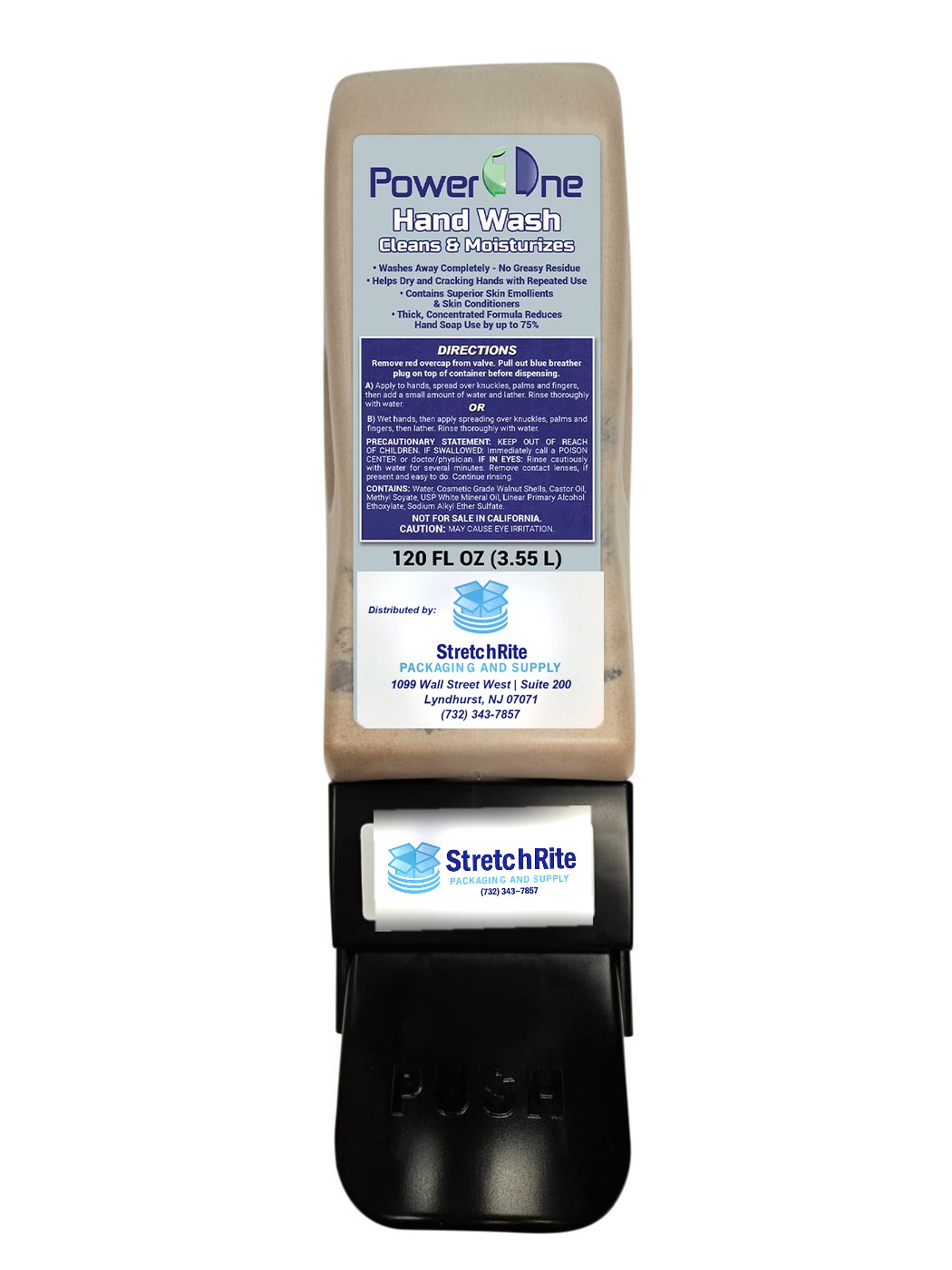 3.55 L + wall dispenser$53.50
Dispenser guaranteed for life
3.55 L + wall dispenser$53.50
Dispenser guaranteed for life -
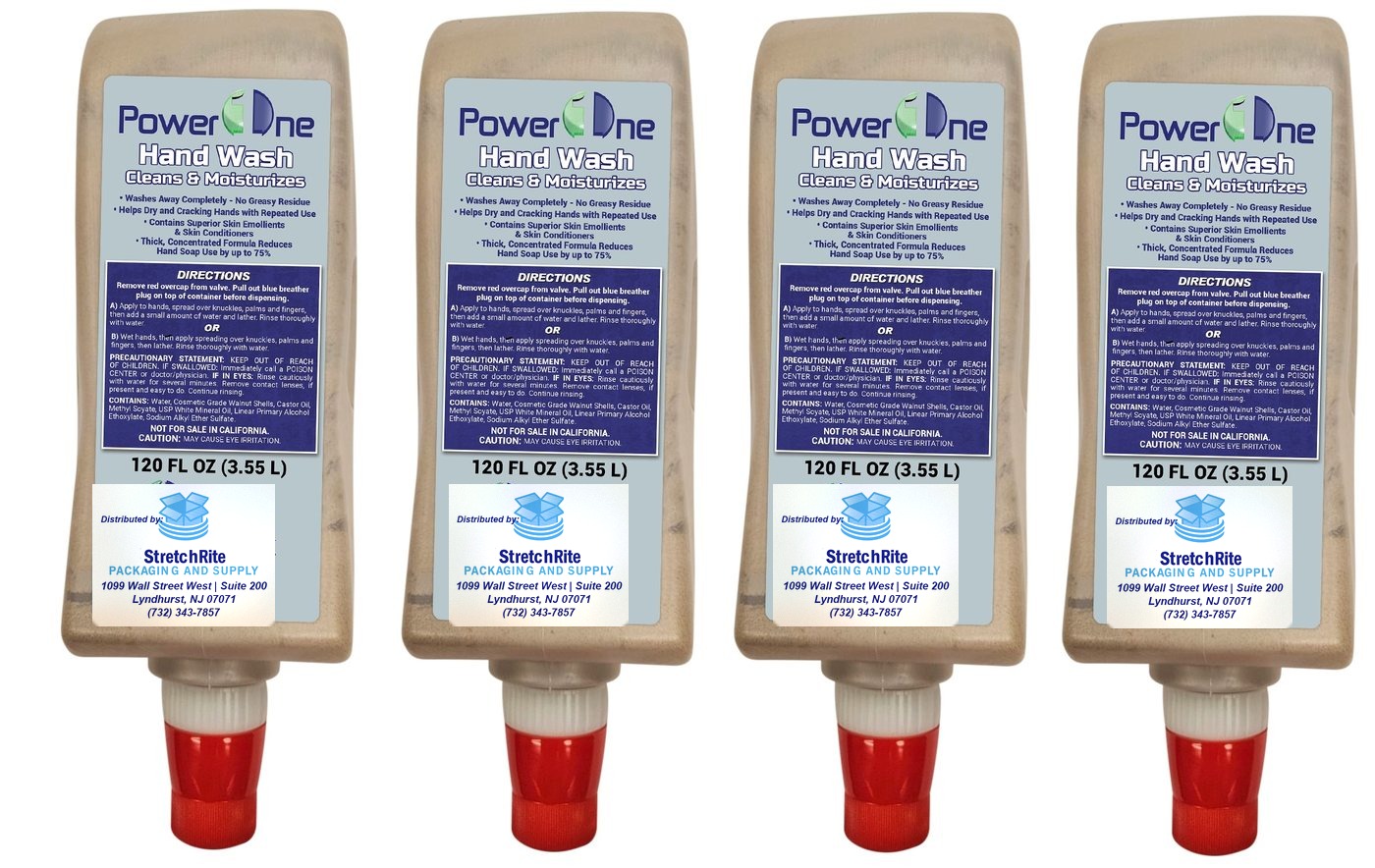 Case of four$140.50
2,840 washes · $9.89/L
Case of four$140.50
2,840 washes · $9.89/L
Of the three, the wall dispenser is the one worth arguing for, and not because of the soap. It is metered, so it gives one measured pump rather than however many somebody feels like taking, and it loads upside-down so gravity pulls the last of the jug into the pump instead of leaving it in the corners. It is guaranteed for life. Mount your dispensers whatever else you buy this quarter.
Beyond that, buy at the size that matches your actual burn rate. A case in the supply closet costs less than four separate jug orders with four separate freight charges — and freight, per the top of this letter, is where this year is quietly getting you.
From the bench

One failure worth knowing how to diagnose: a dispenser that has "gone weak" — soap coming out thin, running off the hands before anyone can work up a scrub, on units that were fine the week before.
Before you call anybody, check whether someone has been topping up the jug with water to stretch it. It is a reasonable instinct and it is the wrong product for it. Power One is already only about 20% water; the rest is the part doing the work, so adding water dilutes the only thing you paid for.
Worth ruling out before assuming the hardware.
Next issue
Three things for November. Whether the August polyethylene nomination actually landed, or went the way of the June nomination that did not stick. A current glycerin assessment, since the most recent defensible reading runs out in April. And an honest working-lifetime cost comparison of the wall dispensers actually on the market — not what they cost at the register, what they cost across a working lifetime including replacements.
Sources
Every figure above, with where it came from. Anything that could not be sourced to this standard is not in the issue.
- USPS 2026 rate increases — USPS newsroom (Ground Advantage +7.8%, Jan 18); USPS time-limited price change (+8%, Apr 26, through Jan 17 2027); TransImpact (Commercial Ground Advantage +11.8%, Jul 12).
- Dimensional divisor 166 → 139, whole-inch rounding, 1 cu ft threshold — USPS Postal Bulletin PB22705.
- UPS +5.9% general increase (Dec 22, 2025) — Loop. Ground Saver $5.00 Non-Compliant Label Fee (Aug 2, 2026) — UPS.
- Polyethylene — export spot 35¢–80¢–62–66¢: PetroChem Wire / OPIS. Implemented contract increases of 5¢, 10¢ and 30¢: Resintel / The Plastics Exchange. June −15¢ and the +30¢ year-to-date position: Plastics News, Material Insights, July 13, 2026. August +5¢ nominations: SABIC and Chevron Phillips producer letters. The withdrawn June nomination is reported in the same Plastics News item.
- LLDPE butene / stretch film — 64¢ March US contract and 77–80¢ April export spot: Argus Global Polyethylene.
- Containerboard and corrugated — index moves netting +$100/ton, the $140/ton September proposal and the 3.9 million tons of retired capacity: Fastmarkets. The ~122 lb/MSF average board weight behind the $6.10/MSF material-cost figure: Packaging Dive, citing the Fibre Box Association.
- Feedstock — crude palm oil RM 4,532 and the 7.2% year-on-year change: MPOB. Palm kernel oil +1.1% and coconut oil −25.7%: World Bank Pink Sheet. Malaysia’s B15 rollout: Bernama. Indonesia’s B50: Indonesian Ministry of Energy. The ~42% crude glycerin move through April: Argus Glycerine / Argus Biofuels assessments.
- New Jersey labor — minimum wage $15.92 and the small, seasonal and agricultural rates: NJ Department of Labor. Commercial cleaning rates: SEIU 32BJ New Jersey contract schedule.
- Power One prices, volumes and wash counts — our own price list; the 710-wash figure is the measured yield of a 3.55 L jug at the 5 mL metered dose.
- GOJO 7255-04 case prices — Masterman’s $113.98 and TC Clean $120.15, both checked August 6, 2026; pack configuration per the GOJO product page.
If a figure in here looks wrong to you, we would rather hear it than not: sales@poweronesoap.com.
Fred Gerstler
StretchRite LLC · 1099 Wall St West, Suite 200 · Lyndhurst, NJ 07071
Frequently asked questions
How often does The Power One Report come out?
Quarterly — four issues a year. We publish when there is enough verified pricing movement to be worth your time.
What goes in the Pricing Notices section?
Dated, attributed changes to what you pay: USPS and UPS rate increases and surcharge changes, polyethylene and containerboard movement, the palm and coconut feedstocks that hand cleaners are made from, and New Jersey labor rates. Every figure carries a source. If we cannot source it, we leave it out and say so in the issue.
What does Power One Soap cost per wash?
About $0.050 per wash on the 3.55 L refill and $0.049 on the case of four, at the metered 5 mL dose that gives 710 washes per 3.55 L jug. The 400 mL bottle works out to $0.149 per wash and is a trial size.
Why do you not compare cost per wash against other brands?
Because cost per wash depends on the dose, and we only know our own. GOJO does not publish a milliliters-per-push figure for the 7255-04 cartridge, so any per-wash comparison against it would rest on an assumption we cannot verify. We compare price per liter instead, which needs only a price and a volume.
Do I have to buy anything to subscribe?
No. The Report is free, and you can unsubscribe from any issue with one click. We do not sell or share the list.
Get the next issue
Dated freight, raw-material and labor pricing notices, four times a year, from Fred Gerstler. Free, and one click to leave.
About the author
Fred Gerstler writes The Power One Report for StretchRite LLC of Lyndhurst, New Jersey. He wrote a pricing letter to One Pack's customers from 2016 to 2020; this continues it.